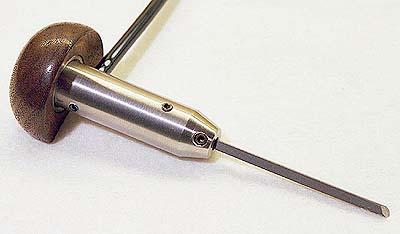
1. Working from the designs invented by my father in 1979,
an improved self oscillation piston principle was patented in 2000.
It can operate with very little air pressure or air volume. In fact, by simply
blowing in it or attaching it to a toy balloon, the tool will idle. Instead of a
spring for the return or impact stroke, the device uses air pressure for both
directions. As a result, the piston always stays balanced and low or high air
pressures can be used without one side overpowering the other causing the piston
to float, which can occur with the spring-pulse designs. The patented idle of
the new design prevents jumps that sometimes occur with spring-pulse designs.
The stroke length and speed adjustment is in the bore of tool. Adjustment is
made by removing the graver and adjusting the screw at the bottom of the tool
hole.
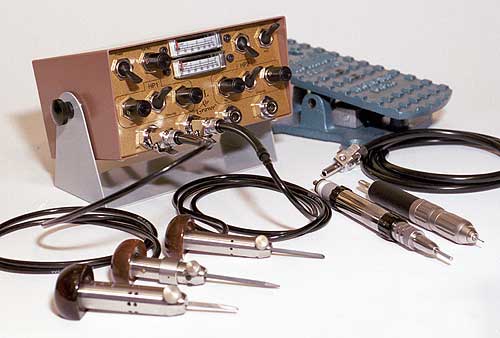
2. A multiple controller box is shown above. Since this box required a lot of work to
manufacture, it was replaced by using either a simple toggle-routing valve on the current foot controller setup, or quick disconnects. This development allows as many
hand pieces and rotaries as needed to be operated at the same time. The basic principle of the
controller for the tool was patented.
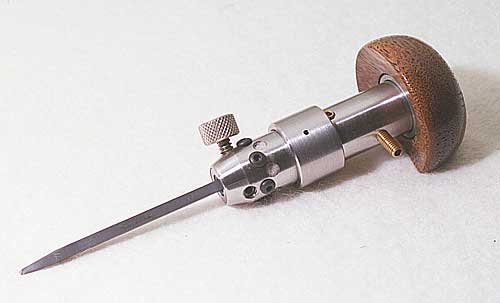
3. One way to move the length-of-stroke adjustment to the outside of the hand
piece was the ring pictured above. Only one of these was made as a prototype and
it was patented when the snap on/off handle was patented. The tool worked nicely,
but it was difficult to make and assemble because of all the small internal
parts.
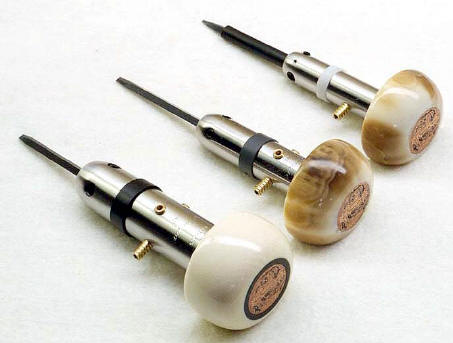
4. In the design shown above, stroke adjustment was still in the tool hole, but
the addition of the black rings around the body made it possible to adjust the
exhaust by turning the ring. When a stroke adjustment was made, the exhaust
could also be tuned to make them run even better.
The stroke adjustment on the tools makes one hand piece as versatile as a
variety of different-sized hand pieces.
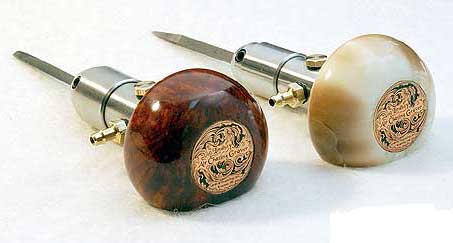
5. I eventually discovered and patented a way to adjust the stroke by moving the nose in and out with a
ring around the body, while simultaneously adjusting (tuning) the exhaust.
Synchronizing the two made the tool run well throughout the stroke range,
without having to adjust one and then the other. The ring works in a manner
similar to focusing a lens on a camera. Because of the way the nose is held in
place, the impacts are isolated to the nose and graver shank. This leads to less
vibration to the body during impacting, and provides significantly more power
when needed.
The stroke adjustment is similar to gears in a car and makes the tool perform like numerous handpieces in
one. First gear is good for shading and fifth gear is good for background. If thinking about it this way, the past blow-pulse machines similar to my father's machine has
one gear.
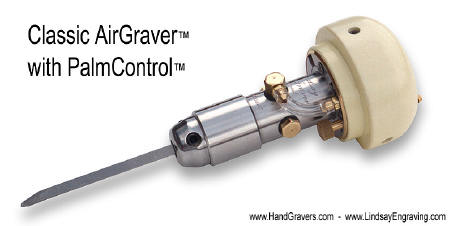
6. The development of the PalmControl meant the
elimination of the foot pedal. I noticed that while engraving with a foot pedal,
engravers also vary the pressure used to hold the graver point in a cut.
Depending on the depth, engravers vary the amount of palm pressure. This idea
was built upon by making a handle that would automatically respond to the palm
pressure to operate the throttle. The concept for the PalmControl was: why do we
have to duplicate with a foot pedal what our hand is already doing? It was also patented. The legal enforceable claims of the patent protect a hand push pressure activated power tool used in the
hand engraving and jewelry fields.
Note: Comments were made by an owner of a competitor that the Lindsay
PalmControl is nothing new. However, the PalmControl technology had not been described or illustrated in a dated public magazine or book one year prior
(June 19, 2001) or any time prior to the priority date of the patent, that anyone or the patent and trademark office is aware of. A publication such as this is termed
proof of valid prior art. The patent issued only after thorough examination by the United States Patent Office, which courts consider the foremost experts in determining
novelty, obviousness, etc. If the engraving world had known of the abilities of this engraving technology, have no doubt that it would have been exploited long ago by a
tool manufacturer.
For further reading Michael Arternis has written an informative article titled insight into the patent system
The PalmControl patent protects a hand push pressure activated power tool used in the hand engraving and jewelry
fields as described in one of the legal claims of patent that is provided below. Infringement of the claims of this patent or any of the Lindsay patents by competitor
tool manufactures will be taken seriously.
"A hand-held power tool for use in hand working operations in the hand engraving and jewelry fields, comprising: a body having first and second ends; a tool tip holder
located at said first end for holding a tool tip; a handle made to be held in the human hand on said body; a variable power means for delivering variable power to said
tool tip; a pressure sensing means for sensing the amount of pressure exerted by a human hand between said handle and said tool tip; said variable power means will
increase in power when said pressure sensing means senses increased pressure exerted by the user of said hand-held power tool on said handle with the human hand; and
said variable power means will decrease in power when said pressure sensing means senses decreased pressure exerted by the user of said hand-held power tool on said
handle with the human hand."